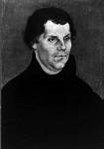
Martin Luther Summary
Martin Luther (1483-1546) was a German professor, composer, priest, monk, educational reformer and a monumental figure in the Protestant Reformation (Brecht, 1985, p. 1). After receiving his bachelors of art and master’s degrees from the University of Erfurt (St. George), Luther began studying jurisprudence. However, after only two months, Luther, who was brought up in austere Catholic sentiment, switched to study in the monastery where he became an Augustinian priest in 1507 against his father’s approval. He continued his studies in philosophy and divinity and soon after “was called to the recently founded University of Wittenberg to teach Aristotle’s Ethics. He spent a year in this position, at the same time continuing his own studies” (Smith, 1911, p. 11). Luther went back to Erfurt for almost two years before going back to a full-time position at Wittenberg. “The theologians he read belonged to what was then called ‘the Modern’ school – ‘the modernists’ of the sixteenth century” (Smith, 1911, p. 12). Luther studied with leading scholar Thomas Aquinas as well as with William Occam and Gabriel Biel; these men shaped Luther’s thinking, and his dissension from Catholicism continued.
Most of all he was helped by John Staupitz, since 1503 the Vicar of the German province of Augustinians, and dean of the faculty of theology at Wittenberg … some have proposed to regard his influence as the decisive factor in the Reformer’s development. (Smith, 1911, p. 14)
Luther was the professor of divinity at Wittenberg from 1512-1517 after receiving his doctorate in theology. Luther began holding lectures on the Bible, which he joyously read continually and started publishing several books and commentaries. He became involved in the indulgence controversy with the Pope in 1517 through 1519. Luther was almost accused of heresy for his opinions about the indulgences for the dead, but people caught on to the scandal. This controversy was sparked on October 31, 1517, when Martin Luther “posted up on the door of the church an announcement of his intentions to hold a debate on the value of indulgences, ‘for the love and zeal for elucidating the truth,’ ninety-five theses or heads for debate being proposed” (Smith, 1911, p. 40). Luther was compelled to recant but did not and resigned as vicar instead.
Luther continued in debates and controversies his entire life while continuing his lectures on the Bible. Luther became the catalyst for a revolt from Rome “It was this union and interaction of forces which produced that great revolution usually known as the Reformation. And of these stirring times Luther was the heart and soul” (Smith, 1911, p. 69).
Luther was good at appealing to the sympathy of the public and became proficient in using the printing press as a PR tool – maybe even the first man to do so (Smith, 1911, p. 76). He was a natural pamphleteer and “an extremely prolific author. His works, in number more than four hundred, fill more than a hundred volumes. He was also an extremely popular author” (Smith, 1911, p. 77).
Luther continued attacking Rome. In 1520 he burned the canon law and the Pope’s bull resulting in his excommunication from the Catholic Church and counsel of the Diet of Worms in 1521. “The Edict of Worms described Luther’s doctrine in the strongest terms as a cesspool of heresies old and new, put him under ban off the Empire, forbade any to shelter him and commanded all, under strong penalties, to give him up to the authorities” (Smith, 1911, p. 120). Furthermore, “It was also forbidden to print, sell, or read his books” (Smith, 1911, p. 120). He was placed in what he called “his Patmos” in Wartburg for over a year. Philip Melanchthon, Luther’s disciple whom he loved, took up the cause in Wittenberg, and the seeds of Luther’s doctrine became planted in fertile soil (Smith, 1911, p. 138). “After pacifying Wittenberg, Luther visited Weimar, Erfurt, and other neighboring places, preaching with great success against fanaticism and sedition” (Smith, 1911, p. 150). In 1524 a peasants’ rebellion began across the Rhine highlands. When it reached Saxony, Luther was asked to be an arbitrator between the peasants and the lords. Luther’s efforts were later instrumental in stopping the murderous peasants. “The Peasants War was the hardest storm weathered by the new church” (Smith, 1911, p. 166).
Luther believed in Bible-centered education, teacher-centered education, education for both boys and girls, that teachers should be highly regarded, that music should be incorporated into education, and that discipline is necessary in education (Kienel, 2005, p. 252).
Martin Luther Critique
Martin Luther was a great writer and educator. He had so much to say about every facet of education. While he was Catholic for much of his life, he was open-minded to the truth of the Word of God. He ultimately came to the conclusion that Jesus Christ is the answer for man’s sinful state and only He alone could forgive man’s sin when man calls upon Him individually. Much of Luther’s work has been compounded and convoluted in religion today, but he was so relevant for the reforming of the church. Luther had no educational journals or teacher colleges for him to attend, yet he advanced the cause of education leading into the Puritan era and continuing through colonial America.
I spent so much time on Luther’s development and personal transformation from Catholic to Christian emphasis in this paper so as to catch not only the internal struggles we face as humans but to show also the progression and reformation of thought in the field of education, both in the genesis of the American education system and even now. We can still undergo great changes in our society and educational system; howbeit, the big wheels of change move slowly. We as Christian educators need to not only take a firm Biblical stand, but we also need to passionately teach students that one’s sphere of influence can cause profound effects where we are as well as on the future.
As probably the most influential Reformation leader, Luther was far superior to his peers when it pertained to pedagogy and publishing too. He did not want the secular writers to negatively influence the Christian students. Luther stated that he had enough to do to get rid of the satanic filth he was obliged to read (Kienel, 2005, p. 247). He wrote so much for the American Puritans to glean from in the education of their children.
References
Brecht, M. (1985). Martin Luther: his road to reformation, 1483-1521 (Vol. 1). Fortress Press.
Kienel, P. A. (2005). A history of Christian school education (Vol. 2). Colorado Springs, CO:
Association of Christian Schools International.
Smith, P. (1911). The life and letters of Martin Luther. Houghton Mifflin.
 Tim Rowe - ABC